The Agentic Workstation: How InsightUW's AI Agents and Human Personas Co-Drive Every Submission and Renewal
InsightUW isn't a workstation with AI features bolted on. It's a workstation built on top of 30+ AI Agents that own bounded tasks across the submission and renewal lifecycle — and a set of human personas (Ops, Underwriters, Senior UWs, Compliance, Management) who hold authority at every gate. The Agents do the screening, extraction, drafting, and routing. The humans hold the decisions. The handoff between them — Agent to Agent, Agent to human, human back to Agent — is the workstation.
TL;DR
| Traditional workstation | InsightUW agentic workstation | |
|---|---|---|
| What the system does | Forms, queues, status fields | Agents that own bounded tasks end-to-end |
| What humans do | Drive every step | Make decisions at authority gates |
| How work flows | Hand-offs via email, Teams, sticky notes | Agent-to-Agent via shared data model; Agent-to-human via the workbench |
| Who's in the loop | UW does almost everything | Right persona at the right step (Ops, UW, Sr UW, Compliance, Mgmt) |
| Audit trail | Free-text notes, screenshots | Immutable rows, automatic retention, single query |
| Cycle time (new submission, normal path) | 5–10 days | 1–2 days |
| Cycle time (renewal) | 7–14 days | 2–4 days |
| Configuration changes | Engineering release | Admin tab edit |
Part 1 — Why "Agentic Workstation," not "AI Features"
Most underwriting platforms today add AI as features — a "summarize this email" button here, a "suggest pricing" widget there. Useful, but structurally still the same workstation: humans drive every step, AI is a side panel.
The agentic workstation is structurally different. AI Agents are the primary actors for bounded tasks; humans are the authority holders at decision gates. The system is composed of agents the way a service-oriented system is composed of services.
| Dimension | AI-as-feature | AI-as-agent |
|---|---|---|
| Trigger | Human clicks a button | System event (submission lands, status changes, time elapsed) |
| Scope | One assist at a time | Bounded task end-to-end |
| Hand-off | Human ferries output to next step | Agent writes structured output that next Agent reads |
| Authority | Human applies own judgment | Authority gate determines if Agent's recommendation can be applied |
| Audit | Optional / manual | Automatic / structured |
| Composition | Doesn't compose | Composes naturally — Agents read each other's outputs |
The structural test: if you removed all the AI from a workstation and the work still got done (slower), it's AI-as-feature. If removing the AI broke the cycle-time SLA fundamentally — because the Agents were doing the bounded tasks humans couldn't do consistently or at scale — it's agentic.
Part 2 — The Lifecycle, the Agents, and the Personas
InsightUW covers seven lifecycle phases. Each phase has Agents doing bounded tasks, and at least one persona who holds the authority gate.
| Phase | What happens | Agents | Persona at the gate |
|---|---|---|---|
| 1. Intake & Triage | Submission classified, extracted, prioritized | Intake Triage · Document Extraction · Prioritization | Ops / Underwriting Assistant |
| 2. Clearance & Compliance | OFAC, duplicates, BOR, auto-declination | Clearance · BOR Conflict · Auto-Declination | UW · Sr UW · Compliance Officer (by severity) |
| 3. Enrichment & Classification | SOV cleansed, NAICS assigned, D&B / news / loss runs pulled | SOV Cleanser · Industry Classification · Submission Enrichment · Loss Run Analyzer · News & Intelligence | Ops (gap-fill) · UW (review) |
| 4. Analysis & Pricing | Summary built, rating run, CAT modeled, pricing recommended | Submission Summary · Rating Orchestration · CAT Modeling · Pricing Recommendation · Risk Assessment | UW |
| 5. Decision & Quote | Referrals routed, quote drafted, follow-ups sent | Referral Routing · Approval Note · Quote Drafting · Endorsement Picker · Follow-up · Missing Info | UW · Sr UW · Manager (by authority) |
| 6. Bind & Issue | Bind request, subjectivity, loss control, binder, PAS sync | Bind Request · Subjectivity · Loss Control · Binder · PAS Sync | UW · AC · Sr UW |
| 7. Renewal & Customer 360 | Renewal generated, pull-forward, exposure compared, T&C diffed | Renewal Generation · Pull-Forward · Exposure Comparison · T&C Diff · Customer 360 | Ops (loop back to intake) |
The lifecycle reads: Ops opens the door · Agents do the structured work · UW makes the decision · Sr UW / Compliance / Management hold the authority gates · Renewal loops back to Ops.
Part 3 — The Workstation Map
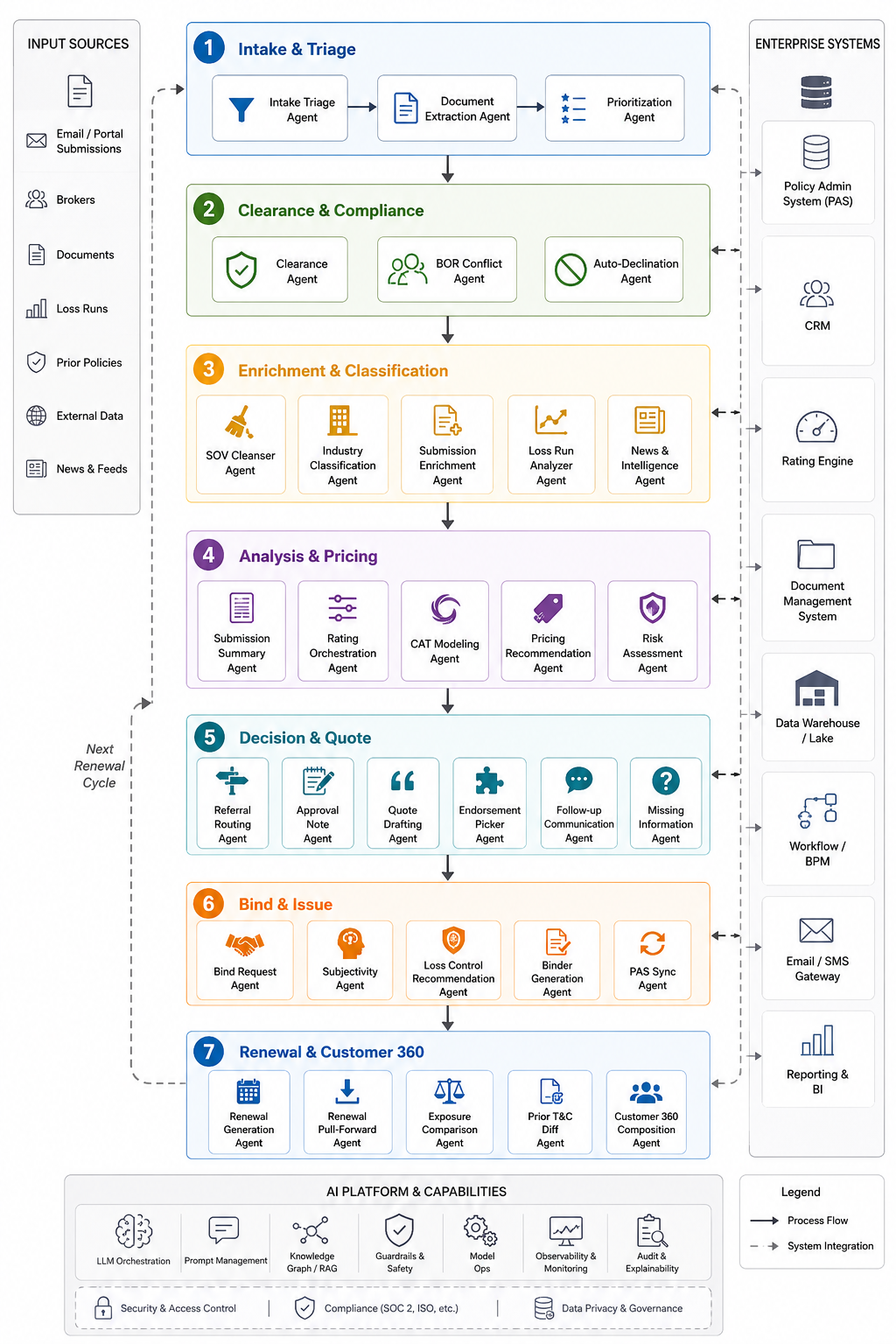
InsightUW's agentic workstation reads top to bottom across seven phases. Input sources on the left feed every phase. Enterprise systems on the right integrate at every phase. The AI platform layer at the bottom is the substrate every Agent sits on. Renewal loops back to Intake, closing the cycle.
Click the image to open at full resolution.
What the map shows
| Region | What lives there |
|---|---|
| Top, phases 1–7 | The lifecycle — Intake & Triage → Clearance & Compliance → Enrichment & Classification → Analysis & Pricing → Decision & Quote → Bind & Issue → Renewal & Customer 360 |
| Inside each phase | The Agents that fire in that phase (3–6 per phase) |
| Left rail — Input Sources | Email / portal submissions, brokers, documents, loss runs, prior policies, external data, news feeds |
| Right rail — Enterprise Systems | Policy Admin / Core Policy Systems, CRM, Rating Engine, Document Management, Data Warehouse / Lake, Workflow / BPM, Email / SMS Gateway, Reporting & BI |
| Bottom — AI Platform & Capabilities | LLM Orchestration, Prompt Management, Knowledge Graph / RAG, Guardrails & Safety, ModelOps, Observability & Monitoring, Audit & Explainability — plus Security & Access Control, Compliance (SOC 2, ISO), Data Privacy & Governance |
| Left margin — dashed loop | Renewal cycle — Renewal Generation Agent feeds the next year's intake |
Three things to notice
- The Agents are the work surface, not a side panel. Every phase is made of Agents. The workstation isn't "the UI with AI added"; it's the orchestration of Agents the UW sees through one workbench.
- Inputs and enterprise systems integrate at every phase, not just at the edges. The PAS, CRM, Rating Engine, and Document Management surfaces are accessible to Agents at every step — the same submission can pull from CRM during Enrichment, the Rating Engine during Analysis, and the PAS during Bind & Issue without any new wiring.
- The AI platform layer is shared. Every Agent uses the same orchestration, RAG, guardrails, audit, security, and compliance primitives. New Agents inherit these for free — they don't reinvent the safety or audit story.
Part 4 — How Agents Hand Off to Each Other
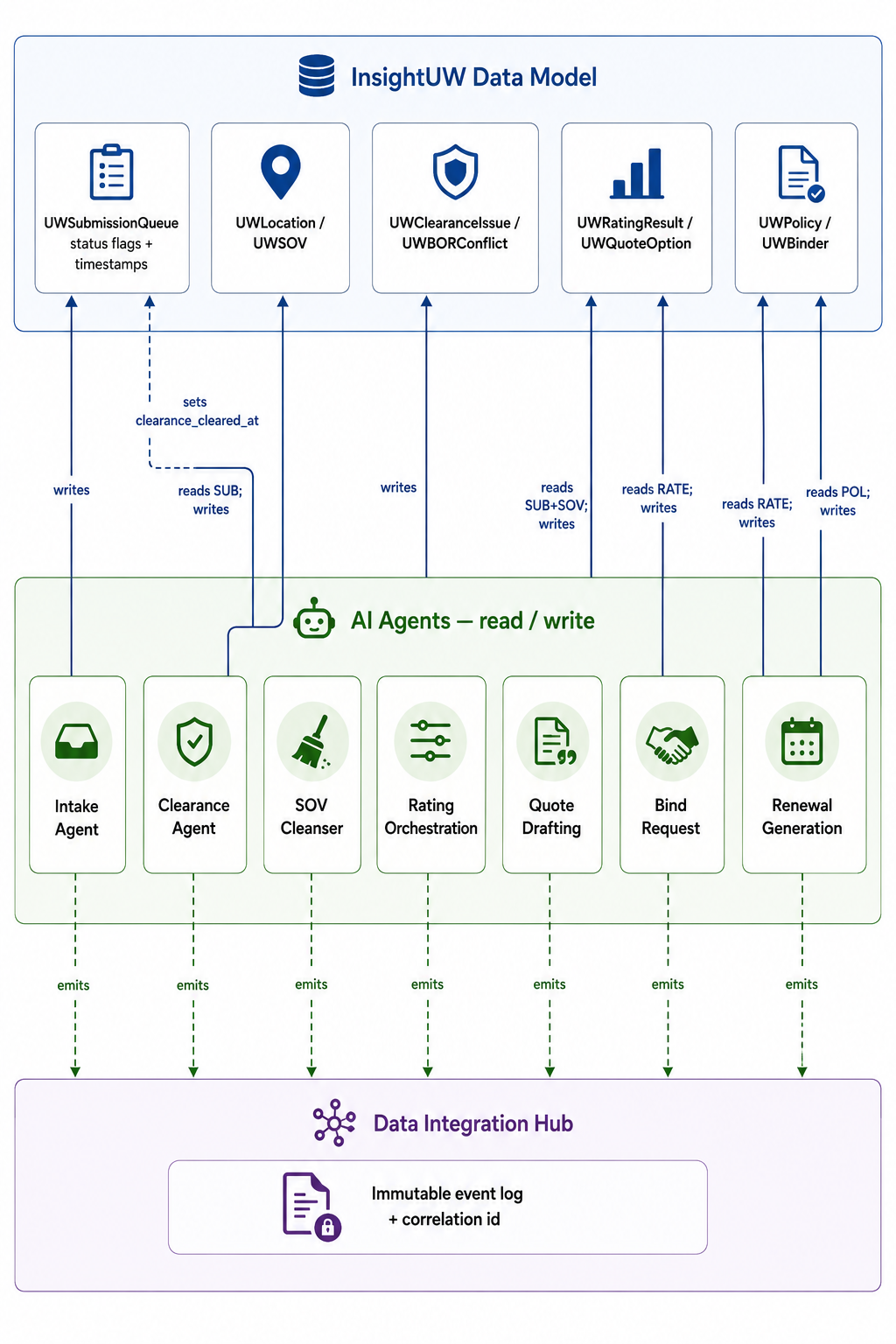
Agents don't call each other directly. They communicate through three contracts:
| Contract | Mechanism | Example |
|---|---|---|
| Data model | Each Agent reads/writes specific tables | Clearance Agent writes Clearance Issue; Submission Summary Agent reads it |
| Status flags | Single boolean/timestamp gates downstream | clearance cleared at unlocks the Rating Orchestration Agent |
| Audit events | Every Agent emits to the Data Integration Hub | Cross-system tracing without point-to-point wiring |
Click the image to open at full resolution.
No Agent-to-Agent direct calls. All composition happens through shared state. Add a new Agent → it reads/writes the same tables → it composes automatically.
Why this matters: when a UW says "the renewal pull-forward used last year's TIV but our SOV Cleanser this year fixed an occupancy code mismatch — does the rating pick that up?" — the answer is yes, because the Rating Orchestration Agent reads the current Location row, not the prior one. No special wiring. The contract is the data.
Part 5 — The Four Human Personas
Agents do the bounded tasks. Humans hold the authority gates. The agentic workstation is precise about which human shows up at which gate.
| Persona | Authority level | When they appear | Examples of decisions they hold |
|---|---|---|---|
| Ops / Underwriting Assistant | 1 | Phase 1 (intake), Phase 3 (gap-fill), Phase 7 (renewal loop-back) | "Is this document complete enough to send forward?" "Did the broker reply with the missing piece?" |
| Underwriter | 2 | Phases 3–6 (most of the work) | "Accept the AI pricing recommendation?" "Merge this duplicate?" "Issue the quote?" |
| Senior UW | 3 | Phase 5 (referrals), Phase 6 (large limit) | "Approve the $25M limit?" "Override the broker-conflict flag?" "Accept the referral note?" |
| Compliance Officer | 4 | Phase 2 (sanctions), Phase 6 (regulatory) | "Clear the 82% OFAC match after EDD?" "Approve the territory exception?" |
| UW Manager / VP | 4–5 | Phase 5 (exception authority), portfolio decisions | "Approve the appetite exception?" "Override the auto-decline?" |
| Chief UW | 6 | Exceptional cases | Top-of-stack authority |
The authority is server-enforced, not a UI hint. An Underwriter cannot clear a sanctions match no matter how many buttons they click. The Clearance Agent's acknowledgment service rejects the attempt with a 403. Authority isn't a polite suggestion — it's a wall.
Part 6 — A Day in the Workstation, Persona by Persona
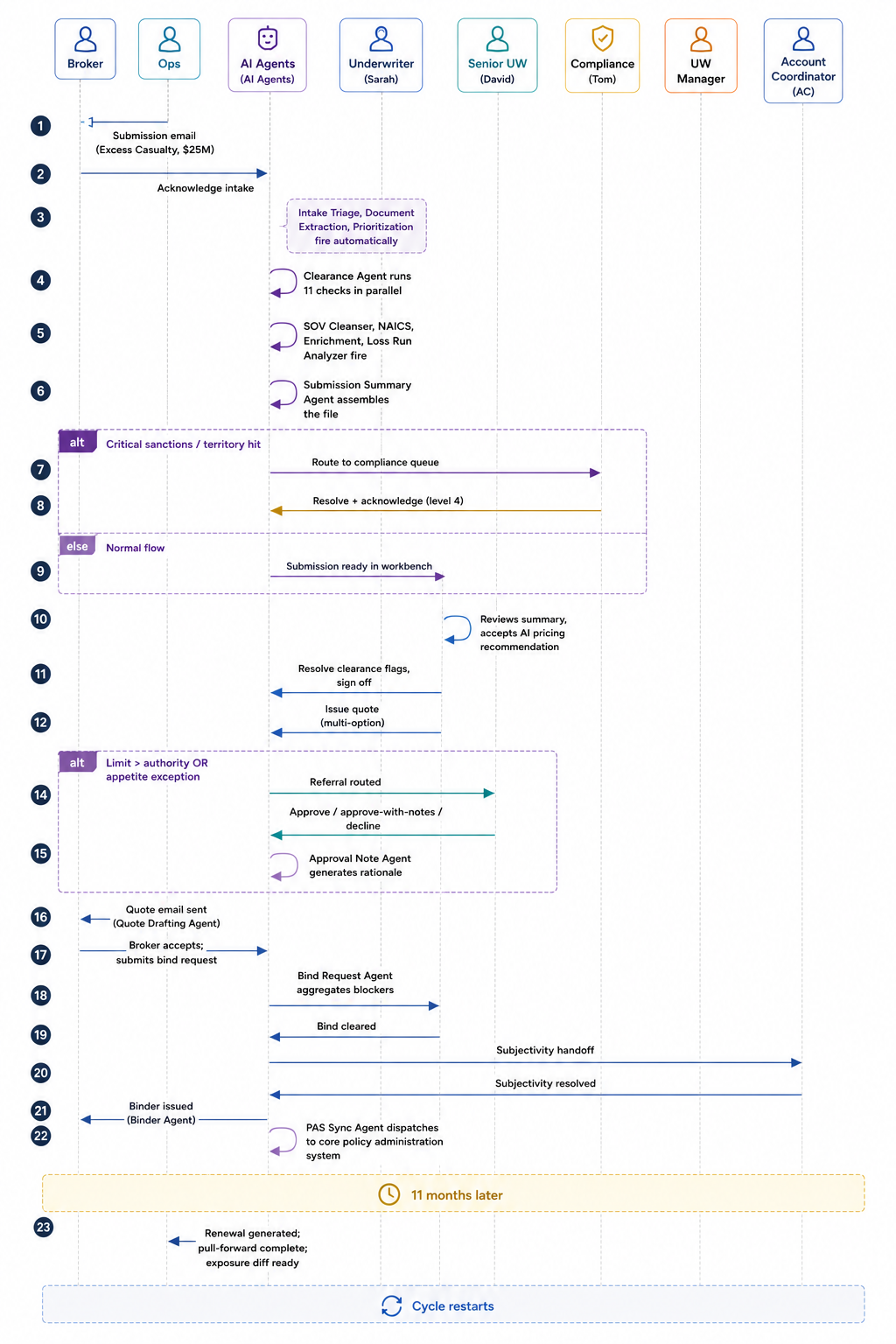
A single submission, walked across the eight actors who touch it — Broker, Ops, AI Agents, Underwriter (Sarah), Senior UW (David), Compliance (Tom), UW Manager, and Account Coordinator (AC). The wall-clock can be 24 hours or 11 months. What stays constant is the pattern: humans appear at authority gates; Agents do the rest.
Click the image to open at full resolution.
Reading the diagram
| Steps | What happens | Who's involved |
|---|---|---|
| 1–2 | Submission email arrives; Ops acknowledges intake | Broker → Ops |
| 3–6 | Agents fire automatically — Intake Triage, Document Extraction, Prioritization, Clearance (11 parallel checks), SOV Cleanser, NAICS, Enrichment, Loss Run Analyzer, Submission Summary | AI Agents (autonomous) |
| 7–8 alt | Critical sanctions / territory hit → compliance queue → Tom resolves at level 4 | AI Agents → Compliance |
| 9 | Normal flow — submission ready in Sarah's workbench | AI Agents → Underwriter |
| 10–12 | Sarah reviews summary, accepts AI pricing, resolves clearance flags, issues multi-option quote | Underwriter |
| 13–15 alt | Limit exceeds authority OR appetite exception → David (Sr UW) reviews and approves/declines → Approval Note Agent generates rationale | AI Agents → Senior UW |
| 16–17 | Quote email sent; broker accepts and submits bind request | AI Agents → Broker → Agents |
| 18–19 | Bind Request Agent aggregates blockers; Sarah clears the bind | Agents → Underwriter |
| 20 | Subjectivity handoff to AC | Agents → Account Coordinator |
| 21–22 | Binder issued to broker; PAS Sync Agent dispatches to the core policy admin system | Agents → Broker / Enterprise |
| 23 | 11 months later — Renewal Generation Agent fires; pull-forward complete; exposure diff ready → cycle restarts at Ops | Agents → Ops |
What the diagram makes obvious
Most rows in the diagram are Agent activity. The humans appear at five specific moments: intake acknowledgment (Ops), submission review and quote issuance (UW), referral approval (Sr UW), compliance resolution when triggered (Compliance), and subjectivity resolution (AC). Everything else — extraction, screening, enrichment, drafting, routing, dispatch — is Agent work.
| Persona | Time in the flow |
|---|---|
| Broker | 3 touchpoints — submit, accept quote, receive binder |
| Ops | 1 touchpoint — acknowledge intake |
| Underwriter (Sarah) | 3 active steps — review/accept, sign off, bind clear |
| Senior UW (David) | Only when referral fires — 1 decision |
| Compliance (Tom) | Only when critical issue detected — 1 resolution |
| Account Coordinator | 1 step — resolve subjectivity |
| UW Manager | Appears only on appetite/portfolio exceptions (not shown in this normal path) |
| AI Agents | Continuously, across all 23 numbered steps |
That distribution — Agents continuous, humans episodic — is what makes the cycle time collapse from 5–10 days to 1–3.
Part 7 — Worked Example: Acme Construction Renewal
A real flow showing the seamless handoff across personas and Agents.
New business, year 1
| Time | Actor | What happens |
|---|---|---|
| Mon 8:40 AM | Broker | Sends submission email — Acme Construction · Excess Casualty · $15M |
| 8:40 AM + 12 sec | Intake Triage Agent | Classifies as new submission; routes to FIFO |
| + 30 sec | Document Extraction Agent | OCRs ACORD form; populates Submission Queue |
| + 45 sec | Prioritization Agent | Scores: appetite fit 84%, broker tier 2, urgency moderate |
| + 9 sec (parallel) | Clearance Agent | 11 checks: 10 pass, 1 flag (DUP-001 — 87% match) |
| + 5 min | Maya (Ops) | Reviews extracted fields; corrects one address typo |
| + 10 min | SOV Cleanser Agent | Normalizes 14 locations; geocodes; fills missing occupancy on 2 |
| + 15 min | Submission Enrichment Agent | Pulls D&B (financials, executives), 6 months of news, OSHA history |
| + 18 min | Loss Run Analyzer Agent | Parses 5-year loss runs; flags one severity trend |
| Tue 9:15 AM | Sarah (UW) | Opens workbench; reviews Submission Summary; resolves DUP-001 (merge) |
| 9:30 AM | Rating Orchestration Agent | Runs Excess Casualty rater; computes adequate-rate band |
| 9:32 AM | Pricing Recommendation Agent | Recommends $145K premium based on rate, loss ratio, peer benchmarks |
| 9:45 AM | Sarah | Accepts recommendation; issues 3-option quote |
| 9:46 AM | Quote Drafting Agent | Renders quote letter; sends to broker |
| Wed 2 PM | Broker | Accepts Option B |
| 2:15 PM | Bind Request Agent | Aggregates blockers (none); transitions to ready-to-bind |
| 3 PM | Sarah | Bind cleared |
| 3:05 PM | Subjectivity Agent | Adds 3 subjectivities; AC handoff |
| Thu | AC | Resolves subjectivities with broker |
| Thu 4 PM | Binder Agent + PAS Sync Agent | Binder issued; dispatched to policy admin system; ack received |
Total cycle time: 3.3 days. Two humans involved (Maya 5 min, Sarah ~45 min). Eleven Agents fired.
Renewal, year 2 (~11 months later)
| Time | Actor | What happens |
|---|---|---|
| Day -45 | Renewal Generation Agent | Auto-creates renewal submission from expiring policy (45-day lead) |
| + 10 sec | Renewal Pull-Forward Agent | Pre-populates with prior policy data, exposure, claims |
| + 20 sec | Exposure Comparison Agent | Three-tier location match: 14 prior locations → 15 current; 12 matched, 2 changed, 1 added |
| + 25 sec | T&C Diff Agent | Compares renewal forms vs prior policy; flags one endorsement change |
| Day -44 | Broker | Sends updated SOV |
| Day -44 + 5 min | SOV Cleanser Agent | Re-cleanses; updates location 15 with broker-supplied geocode |
| Day -43 | Maya (Ops) | Reviews exposure diff and T&C flag; both look intentional |
| Day -42 | Clearance Agent | Re-runs 11 checks (renewal is a re-clearance event); all pass |
| Day -40 | Sarah (UW) | Opens renewal; reviews exposure diff, T&C diff, claims update |
| Day -40 + 15 min | Sarah | Notes TIV grew 22%; refers to Sr UW for capacity review |
| Day -39 | Referral Routing Agent | Routes to David (Sr UW); generates approval note |
| Day -38 | David | Approves with note: "TIV growth driven by 1 new site; reinsurance unaffected" |
| Day -38 + 1 hr | Sarah | Issues renewal quote |
| Day -30 | Broker | Accepts |
| Day -29 | All bind / binder / PAS agents | Renewal bound and dispatched |
Total renewal cycle: 14 days (well ahead of the 45-day target). Three humans involved (Maya 15 min, Sarah ~75 min, David ~30 min). Fourteen Agents fired.
What the manual flow would have looked like: Maya spending half a day re-doing screening, two days reconstructing the exposure schedule, a back-and-forth email chain over the T&C change, a separate spreadsheet for capacity, and the renewal hitting the deadline by hours instead of weeks.
Part 8 — How the Workstation Stays Seamless
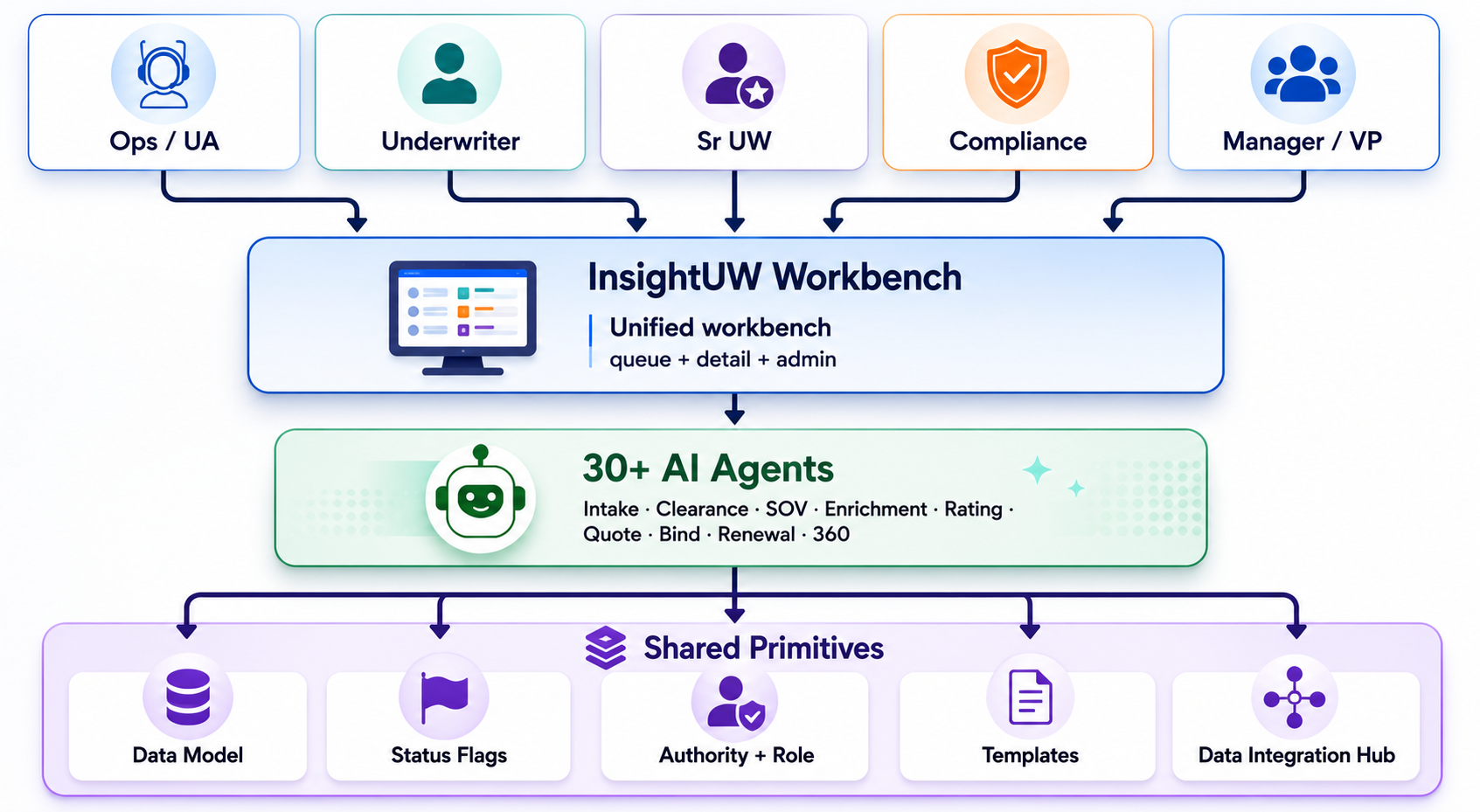
The handoffs between Agents, between Agents and humans, and between humans across personas all rely on five shared primitives. Every Agent uses them. Every UI surface uses them.
| Primitive | What it provides | Why it makes handoffs seamless |
|---|---|---|
| Shared data model | Every Agent reads/writes the same tables | New Agents compose without point-to-point integration |
| Status flags | Single timestamps (clearance cleared at, bind at, renewed at) | Downstream services know exactly when to fire |
| Authority & role service | Server-enforced role hierarchy | Right human at right gate; no honor system |
| Notification + email templates | Centralized template library; voice-profile aware | Outbound communication is consistent across Agents |
| Data Integration Hub | Single immutable audit + correlation id | One query for end-to-end trace; one source for exam evidence |
Click the image to open at full resolution.
One workbench. Five personas. Thirty Agents. Five primitives. That's the whole picture.
Part 9 — Outcomes Across the Lifecycle
| Metric | Without InsightUW | With InsightUW agentic workstation |
|---|---|---|
| New-business cycle time (normal path) | 5–10 days | 1–3 days |
| Renewal cycle time (45-day target) | Hit ~70% of targets | Hit ~95% of targets |
| Submissions per UW per week | 8–15 | 25–40 |
| Sanctions / clearance consistency | Analyst-by-analyst | 100% uniform |
| Authority violations (UW clearing sanctions, etc.) | Recurring | Zero (server-enforced) |
| Audit retrieval (DOI exam) | Days of folder pulls | Single query |
| Broker follow-up turnaround | Days (manual draft) | Hours (voice-profile auto-draft) |
| Configuration changes (threshold, appetite) | Memo + retraining | Admin tab edit |
| Cross-system traceability (workstation ↔ PAS) | Spreadsheet reconciliation | One correlation id |
| Renewal pull-forward accuracy | 60–80% (manual) | 95%+ (Agent-driven) |
Part 10 — What This Means
Underwriting at machine speed isn't about replacing the underwriter. It's about removing everything the underwriter shouldn't be doing.
The pre-agentic workstation asks the UW to:
- Open OFAC's website and type the insured name
- Scroll the queue spreadsheet looking for duplicates
- Email the LOB manager for a capacity confirmation and wait a day
- Hand-write disposition notes that nobody can audit cleanly
- Re-type prior-policy data into a renewal form
The agentic workstation puts an Agent in front of each of those tasks and asks the UW to do what only they can: make the decision, hold the authority, apply the judgment.
| The Agents own | The humans own |
|---|---|
| Structured screening at uniform thresholds | The disposition call when the screening flags an ambiguous case |
| Data extraction from unstructured documents | Verification when the extracted field is critical to pricing |
| Pricing recommendations based on rates + losses + peers | Whether to accept, override, or refer the recommendation |
| Drafting broker emails in the carrier's voice | Whether to send, edit, or rewrite |
| Comparing exposure year over year | Whether the change is benign or material |
| Routing referrals to the right authority | The approve / decline call at the gate |
| PAS dispatch and reconciliation | Resolving a failed dispatch |
That separation — Agents for the bounded tasks, humans for the judgment and the authority gates — is what makes the workstation seamless across Ops, UW, Sr UW, Compliance, and Management.
What's Next
Subsequent posts will walk through specific Agent handoffs in depth:
- The Pricing Recommendation Agent — how it composes rate adequacy + win probability + peer benchmarks into one number
- The Renewal Pull-Forward Agent — how it pre-populates the renewal submission and stays in sync when the broker submits the updated SOV
- The Subjectivity Agent — how it manages the AC handoff and tracks the lifecycle without burdening the UW
Want to see how InsightUW's agentic workstation moves a submission from intake to bind in days, with the right human at every authority gate? Request a demo.