Inside the Prioritization Agent: Six P&C Scenarios Showing How InsightUW Ranks Every Submission in the Queue
Once the Intake Triage Agent has classified an inbound as a real submission, a second question has to be answered before an underwriter ever opens it: which one do I work first? A commercial P&C team gets 200–800 submissions a day. Some are marquee renewals from a key broker with inception in six days; some are $2M new-business shots from a walk-up broker effective next quarter. The Prioritization Agent scores every submission across seven weighted business factors, produces a 0–100 number and a HIGH / MEDIUM / LOW band, and orders the queue — deterministically, with a written rationale on every score.
The architecture in one picture
The Prioritization Agent is a deterministic, rule-based scorer — not a black-box model. Seven factors, each with a fixed maximum, sum to a 0–100 score. The LLM's only job is to narrate why the score came out the way it did in plain English; it never sets the number. That split matters: the ranking is fully explainable and reproducible, and the same submission always scores the same way regardless of model drift.
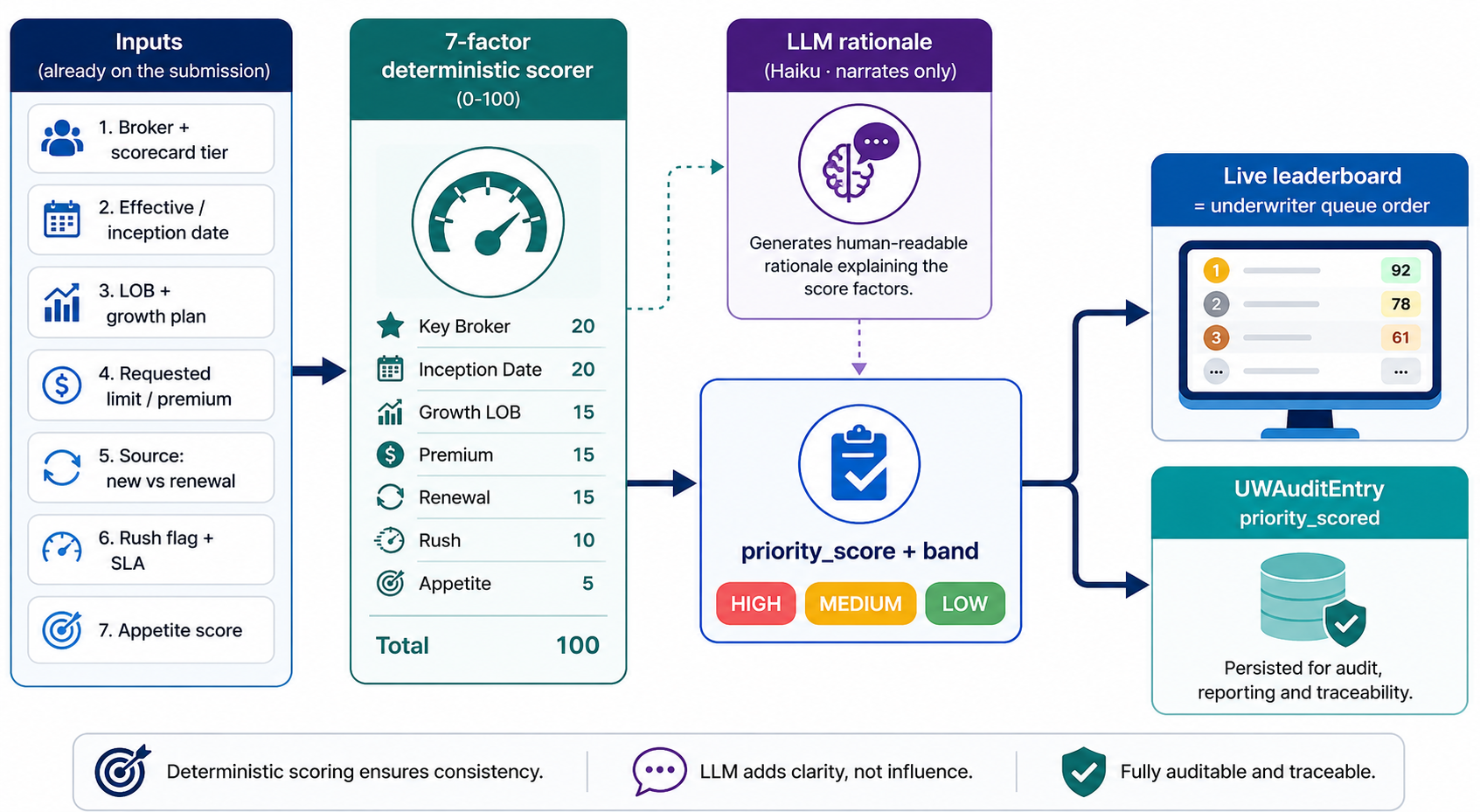
priority_score and a HIGH / MEDIUM / LOW band. The LLM narrates the rationale for clarity but never sets the number; the outputs drive the live leaderboard (the underwriter queue order) and a UWAuditEntry persisted for audit and traceability.Click the image to open at full resolution.
The seven factors
Every factor is capped, so no single signal can dominate. A submission can only reach HIGH by stacking real business reasons — a key broker and imminent inception and a growth line, or a renewal and a rush event.
| # | Factor | Max | Logic |
|---|---|---|---|
| 1 | Key Broker | 20 | Key tier = 20, Preferred = 12, Standard = 0 (from the broker scorecard) |
| 2 | Inception Date Proximity | 20 | ≤7d = 20, ≤14d = 16, ≤30d = 12, ≤60d = 6, >60d = 2 |
| 3 | Growth Target LOB | 15 | Cyber = 15, Environmental = 12, D&O = 10, E&O = 8, others = 0 |
| 4 | Premium Size | 15 | ≥$25M = 15, ≥$10M = 12, ≥$5M = 8, ≥$1M = 4, <$1M = 1 |
| 5 | Retention / Renewal | 15 | Renewal = 15, New business = 0 |
| 6 | Rush Submission | 10 | Rush = 10, Normal = 0 |
| 7 | Appetite Fit | 5 | ≥80 = 5, ≥60 = 3, >0 = 1, none = 0 |
The three bands
HIGH (70–100) — the drop-everything work. A key broker with imminent inception on a growth line, a large renewal, or a rush event stacked on real premium. Pinned to the top of the workbench queue; these are what the day should be spent on.
MEDIUM (40–69) — real work with some, but not all, accelerants. A marquee account from a key broker that happens to be a non-growth line; a growth-line account from a preferred broker. It gets worked, in order, after the HIGHs.
LOW (0–39) — standard broker, distant inception, small premium, new business. Not ignored — correctly ranked below the work that actually moves the book today, so nothing gets lost but nothing marginal jumps the line.
Six P&C scenarios
Each card below is a real submission scored by the engine. The factor math is shown exactly as it sums — the number is never a vibe, it's an addition. The "What the UW sees" line is the outcome on the InsightUW workbench and the live leaderboard.
Scenario 1 · Large D&O renewal from a key broker, inception in 12 days HIGH · 78
UWAuditEntry · action=priority_scored · priority=high · priority_score=78 · performed_by=priority_engineScenario 2 · Cyber new business with an active-incident rush flag HIGH · 76 · RUSH
is_rush=true (intake caught "ransomware" — 2h SLA)UWAuditEntry · action=priority_scored · priority=high · priority_score=76 · rush=trueScenario 3 · Large Property account — great, but no accelerant fires MEDIUM · 57
UWAuditEntry · action=priority_scored · priority=medium · priority_score=57Scenario 4 · A smaller E&O account pulled up by the growth plan MEDIUM · 44
UWAuditEntry · action=priority_scored · priority=medium · priority_score=44Scenario 5 · Small WC shot from a walk-up broker, effective next quarter LOW · 11
UWAuditEntry · action=priority_scored · priority=low · priority_score=11Scenario 6 · A CAT watch re-ranks a Property renewal mid-morning RE-RANK · 52 → 62
score-all pass ranked Gulfport Terminals (Property renewal, $12M, inception 21 days) at 52 — #38 on the leaderboard.is_rush); POST /score-all re-runs.UWPrioritySignal that pins the account for review, independent of the seven-factor score.UWAuditEntry · action=priority_scored · priority_score=62 · reason=rush_rescore · trigger=cat_watchHow the score is computed — and why it's deterministic
The merge is not a model call. Each factor is a lookup against config, the results are summed, and the band is a threshold on the total:
- Every factor is a table lookup. Broker tier from the scorecard, inception bucket from the effective date, growth weight from the strategic plan, premium tier from the requested limit. No factor is subjective, so two underwriters — or two re-runs a week apart — get the identical number.
- The sum is the score; the band is a threshold. 70+ is HIGH, 40–69 MEDIUM, below 40 LOW. There's no rounding away of the reasoning — the
priority_rationaleJSON stores every factor's contribution so the workbench can render the full breakdown, not just the total. - The LLM narrates, it does not decide. Claude Haiku turns the factor array into the one-line human rationale ("key broker · growth line · imminent inception"). If the model were unavailable, the number and band are unchanged — only the prose sentence would fall back to a templated string.
- Re-scoring is cheap and continuous.
score-allre-runs across the open book on a cadence and on any material change (rush flag flips, appetite score lands, inception ticks into a closer bucket), so the leaderboard reflects reality, not the state at submission time.
What the agent does — and what it doesn't
Prioritization has a deliberately narrow job: rank the queue. It consumes signals other agents produce and it never makes an underwriting call.
| The agent does | The agent does NOT |
|---|---|
| Score every submission 0–100 across seven business factors | Decide appetite fit — it only reads the appetite score (that's the Appetite model) |
| Assign a HIGH / MEDIUM / LOW band and order the leaderboard | Judge submission readiness — that's the Quality Scoring Agent's 7 dimensions |
| Re-score on material change and on a batch cadence | Extract or validate fields — that's the Document Extraction Agent |
| Write the factor-by-factor rationale and audit row | Run sanctions / capacity / BOR checks — that's the Clearance Agent |
| Honor the rush flag and inception proximity in real time | Detect rush at intake — the Intake Triage Agent sets is_rush; this agent consumes it |
| Surface claims-driven priority signals on the leaderboard | Decide to decline — that's the Auto-Declination Agent |
Priority is one of three scores
Prioritization answers "is this important?" — but the workbench shows it alongside two sibling scores so the underwriter has the full picture before opening a submission. Priority tells you what to work; quality tells you whether it's ready to work; appetite tells you whether it fits.
| Score | Question | Signals |
|---|---|---|
| Priority (0–100) | Is it important — work it now? | Broker tier, inception proximity, growth LOB, premium, renewal, rush, appetite fit |
| Quality (0–100) | Is it ready — can I actually work it? | Document + data completeness, clearance status, classification, appetite alignment, freshness, broker responsiveness |
| Appetite (0–100) | Does it fit — should we even want it? | LOB fit, industry class, limit vs capacity, territory, loss history |
A submission that's HIGH priority but LOW quality tells the underwriter something specific: this matters, but chase the missing docs before you spend time on it. That's the combination the three-score model exists to make visible.
Tunables a carrier owns
Every weight, tier, and threshold the agent uses is meant to be admin-owned per tenant — the score encodes the carrier's strategy, and strategy changes without an engineering release:
- Broker tiers — which brokers are key vs preferred vs standard (reference data on the scorecard)
- Growth-target LOBs and their weights — this quarter's strategic plan (Cyber 15, Environmental 12, D&O 10, E&O 8 by default)
- Inception-proximity thresholds — the 7 / 14 / 30 / 60-day buckets
- Premium tiers — the $1M / $5M / $10M / $25M breakpoints
- Band cutoffs — where HIGH / MEDIUM / LOW split (70 / 40 default)
- Rush weight — how hard a rush event pulls a submission up
- Re-score cadence — how often
score-allsweeps the open book - Claims-signal thresholds — what loss activity raises a priority signal on the leaderboard
Why this matters for P&C
Without a scoring engine, queue order is whatever's on top of the inbox — newest first, or loudest broker first. Rush submissions sit until someone opens them; growth-line accounts the carrier is actively trying to win get the same attention as a $1M walk-up; and no one can explain why one submission got worked before another.
| Outcome | Inbox-order triage | InsightUW Prioritization Agent |
|---|---|---|
| Queue order | Newest-first, or whoever emails most | Ranked by seven weighted business factors |
| Rush / CAT submissions | Noticed when someone opens the email | Pulled to the top on the rush flag, re-scored live |
| Growth-line focus | Invisible — depends on the UW remembering the plan | Encoded as a factor weight; growth LOBs rise automatically |
| Renewal retention | Easy to miss under new-business volume | +15 renewal factor keeps in-force business front of queue |
| Explainability | "I just worked it in the order it came" | Factor-by-factor rationale + audit row on every score |
| Consistency | Varies by underwriter and by day | Deterministic — same inputs always produce the same rank |
What's Next
This post covered the Prioritization Agent and its place in the three-score model. Subsequent posts will go deeper on:
- The Quality Scoring Agent — the seven readiness dimensions, how document and data completeness are measured against the missing-info tracker, and how quality gates the work before priority sends it to the top
- The Appetite model — LOB fit, limit-vs-capacity, territory, and loss-history scoring, and how appetite feeds both priority and the auto-declination path
- The Claims-Driven Priority Signal service — how loss activity on an in-force insured raises a leaderboard signal independent of the seven-factor score
Want to see the Prioritization Agent rank your actual open book — with the factor-by-factor rationale on every submission and a live re-score when a rush event fires — in a 45-minute working session? Request a demo.