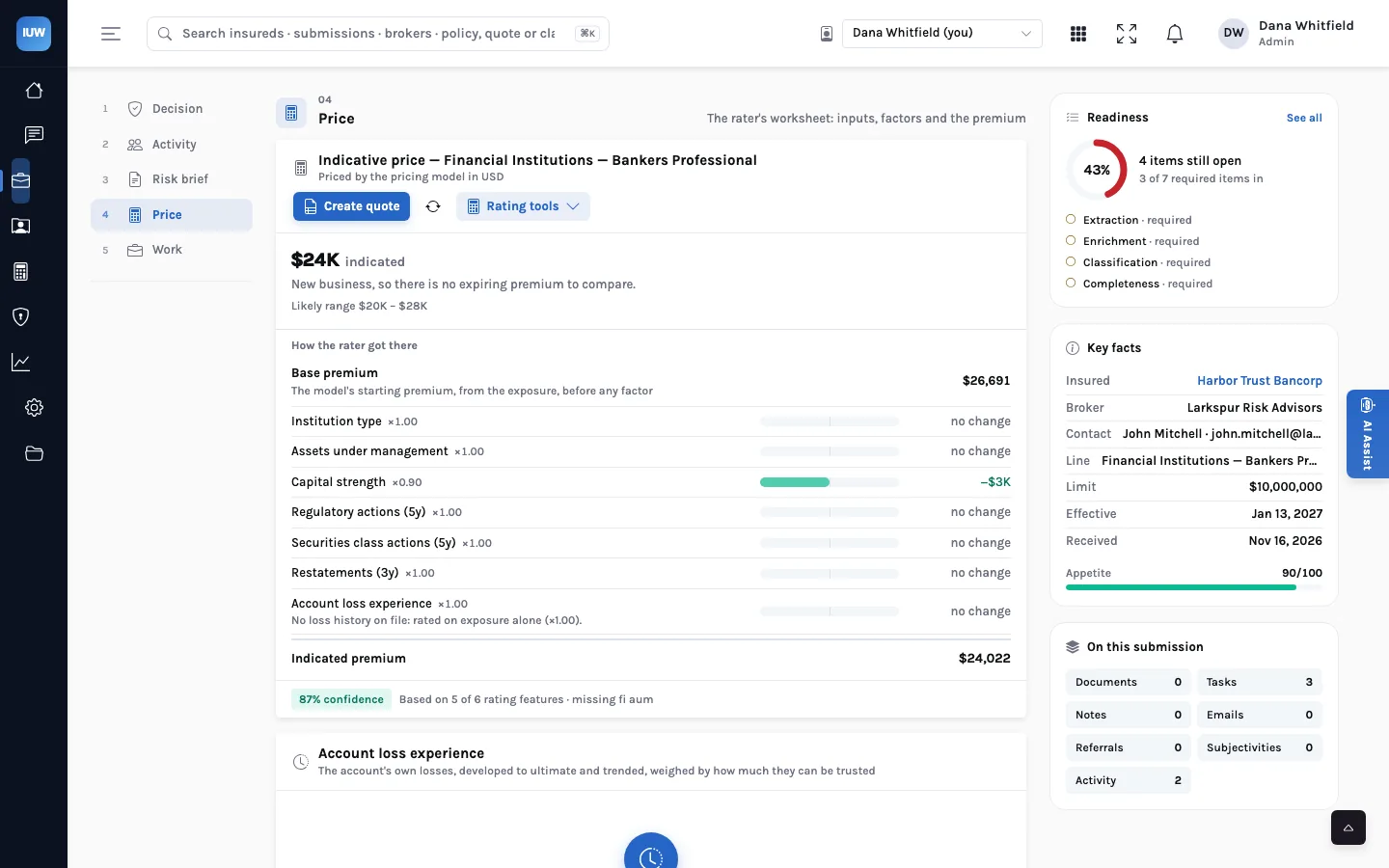
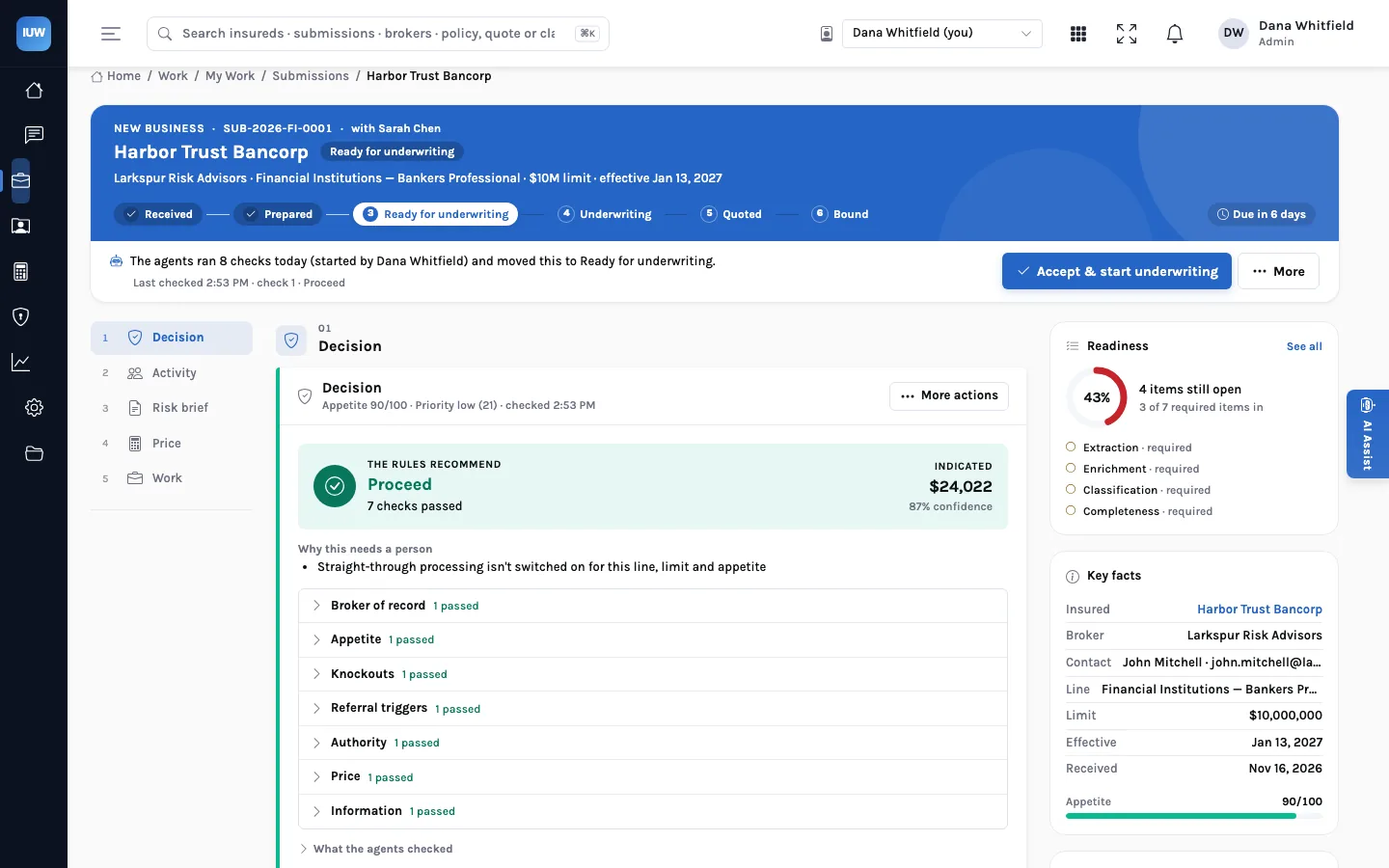
“How autonomous is the AI?” is the first question an underwriting leader asks, and the honest answer is: as autonomous as you set it, for each thing it does, on each line you write. InsightUW makes that a dial a manager turns, with four positions and a ceiling.
In short
- Four levels: L1 draft only, L2 ask first, L3 act and tell, L4 act.
- Set per agent, per action and per line: the intake agent may chase brokers on its own for one line and only draft for another.
- Capped twice: by the checkpoint rule's own level and by a tenant ceiling for the whole carrier. A kill switch drops any agent to L1.
- Promotions are earned from people's answers to the agent's prepared decisions, and a manager accepts them; a run of disagreement demotes at once.
The four levels
At L1 the agent drafts and a person does the work. At L2 it prepares the decision and parks it for a person, which is what a checkpoint's prepared decision is. At L3 it acts, tells the person and allows a pull-back. At L4 it acts. The agents and their actions include the intake agent (go ahead when information is missing, chase the broker), appetite, pricing, referral (authority), straight-through quoting, quote sending and follow-ups, bind, decline and renewal terms.
The Autonomy page
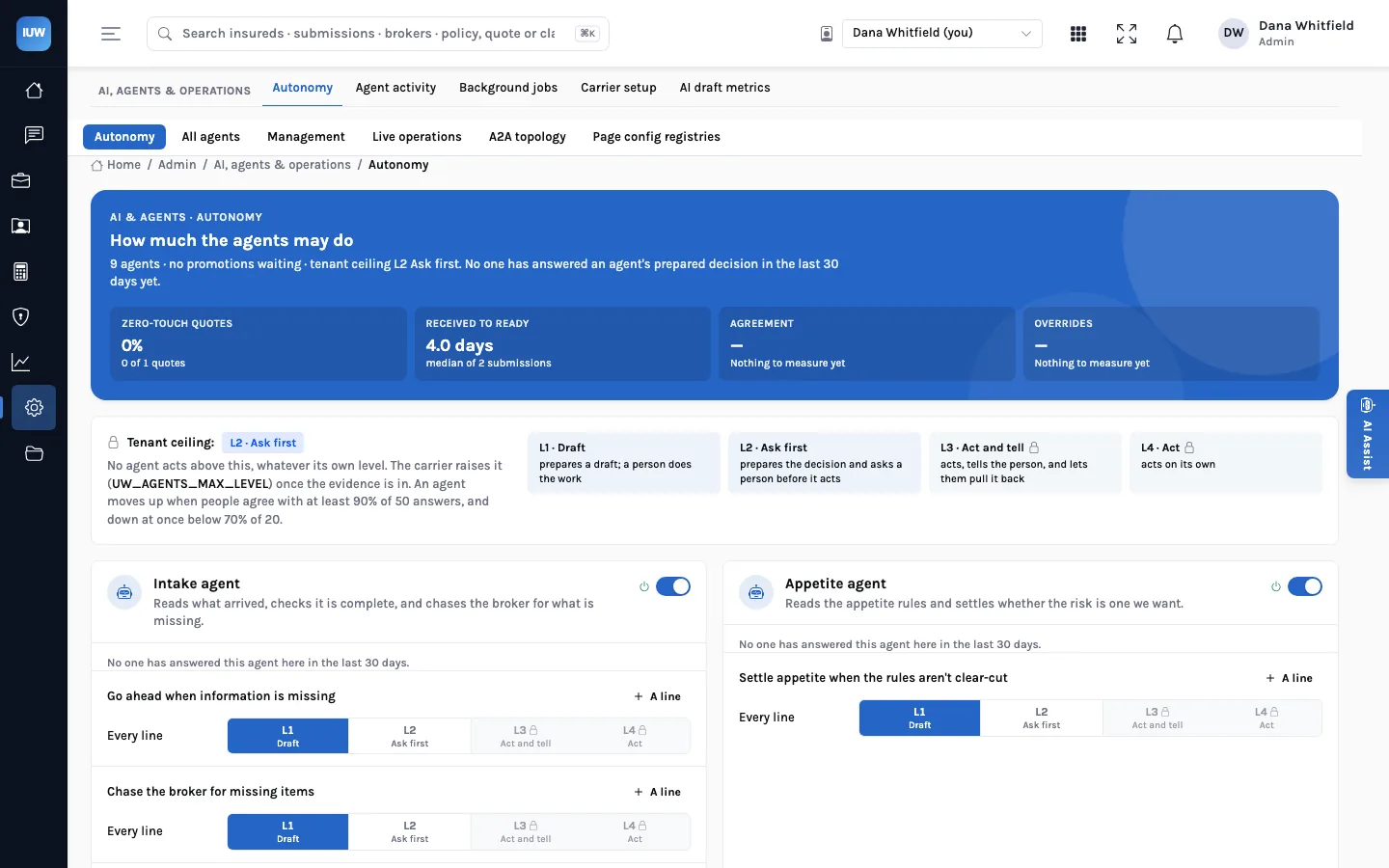
Under Admin, AI, agents & operations, the Autonomy page shows how much the agents may do: the number of agents, promotions waiting, the tenant ceiling, and four numbers for the last 30 days (zero-touch quotes, time from received to ready, agreement and overrides). Each agent has its own card with an on/off switch and, for each action, the level per line.
Three caps
- The checkpoint rule's level. A rule can say, for example, that a price checkpoint on a line never goes above L2, whatever the agent is allowed elsewhere.
- The agent's level for that line and action, which a manager sets.
- The tenant ceiling, one carrier-wide maximum, set in the deployment's configuration (L2 by default). In the screenshot it is L2, so no agent acts on its own anywhere, whatever its cards say.
And the kill switch: an agent switched off runs at L1, drafting only.
Earning a notch
Every time a person answers a prepared decision (accept, change or reject), that answer is recorded as feedback. An hourly job rolls the last 30 days up per agent, line and action into an agreement rate: accepted divided by accepted plus changed plus rejected.
| Rule | Threshold | What happens |
|---|---|---|
| Recommend a promotion | agreement of 90% or more over at least 50 answers | A manager is offered the promotion and accepts or ignores it |
| Demote | agreement below 70% over at least 20 answers | The level drops at once; the change is audited and managers are told |
Promotion is a recommendation a manager accepts; demotion is automatic. Run costs come from the recorded agent runs.
Watching what the agents did
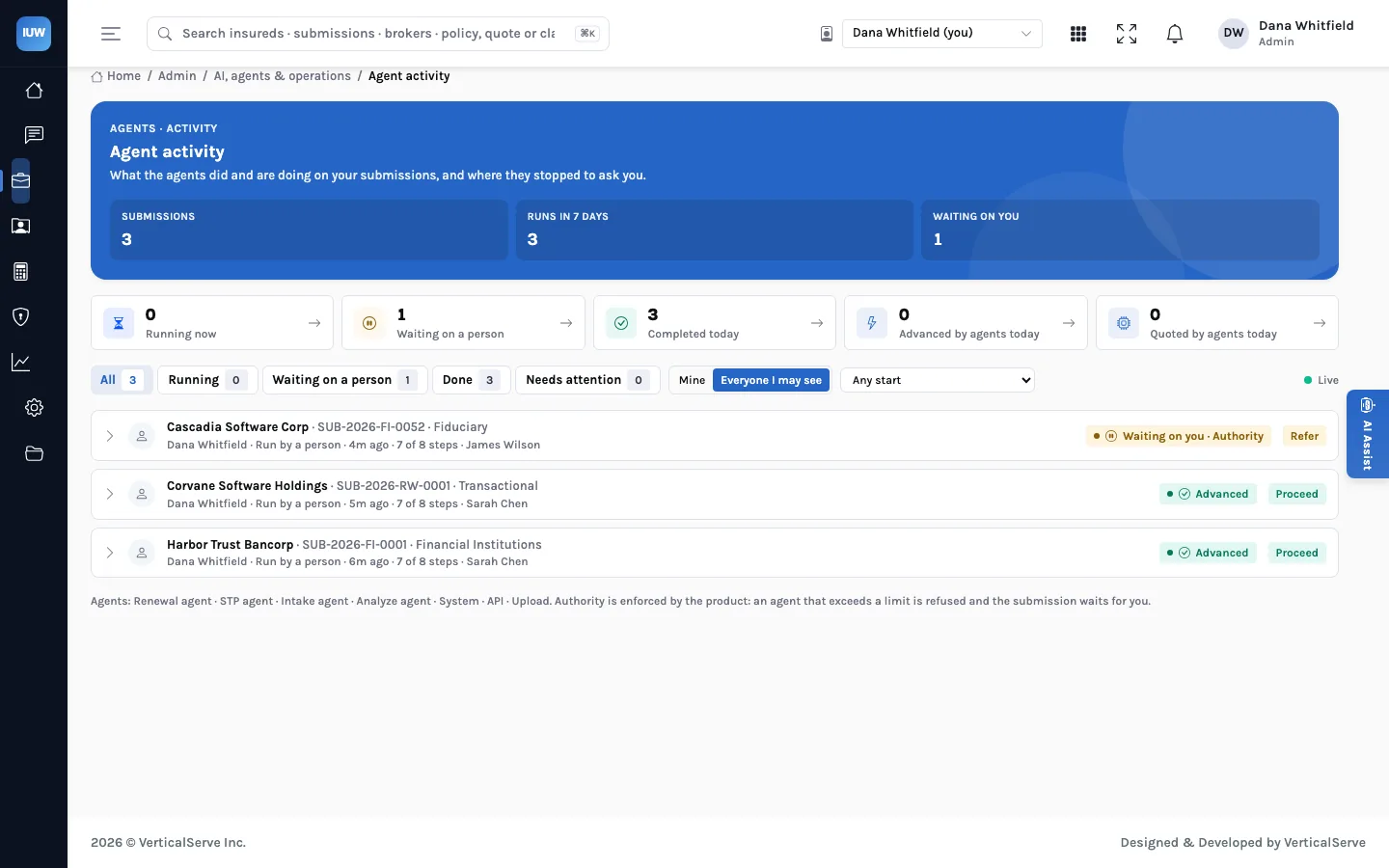
Agent activity lists the runs: running now, waiting on a person, completed today, advanced by agents today and quoted by agents today, with each run's submission, who started it, its steps and where it stopped.
Starting cautiously
The fictional Harborline Specialty sets its tenant ceiling to L2 for the first quarter: every agent prepares, none acts alone. After a few months the Autonomy page shows the intake agent's chase the broker action on crime with a high agreement rate over enough answers, and offers a promotion to L3. The head of underwriting accepts it for crime only, has the deployment's ceiling raised to L3, and leaves every other line and action where it was.
Shipped cautious
The tenant ceiling defaults to L2, set in the deployment's configuration rather than on a screen; decline is a checkpoint that always asks a person; and straight-through quoting is off until a carrier switches it on for a line.
The starting levels
Each agent's actions start at the level of the checkpoint rule behind them, so switching the dial on changes nothing on day one:
| Agent | Action | Starts at |
|---|---|---|
| Intake | go ahead when information is missing · chase the broker | L1 · L1 |
| Appetite | settle appetite when the rules aren't clear-cut | L1 |
| Pricing | accept the indicated price | L1 |
| Referral | send referrals up the line | L1 |
| Straight-through | quote clean submissions straight through | L3 (but the policy is off, and the L2 ceiling caps it) |
| Quote | send quotes to the broker · follow up on quotes that went quiet | L2 · L2 |
| Bind | bind | L2 |
| Decline | decline and send the letter | L2 |
| Renewal | propose renewal terms | L1 |
What happens at the gate at L3
When Analyze parks a submission, the gate works out the effective level for the agent behind each checkpoint that fired. The agent settles the submission itself only when every checkpoint that fired belongs to an agent at L3 or above, and none of them is a decline. It then takes the recommended action, records the sign-off as the agent's with its level, and tells the assigned underwriter in the app: what it did, at which level, and that they can open the submission to review or change it. If even one checkpoint's agent is at L2, a person answers.
Straight-through quoting follows the same logic. Even with the policy switched on for a line, the straight-through agent quotes only when its effective level reaches L3, so with the ceiling at its default of L2, nothing is quoted without a person.
What counts as evidence
- Accept, change and reject are counted. Agreement is accepted divided by all three.
- Skips are recorded but left out of the rate; asks record nothing, because a question isn't an answer.
- Only people's answers count. An agent settling a checkpoint at L3 doesn't vote for itself.
- One notch at a time. A promotion offers the next level up, never a jump from L1 to L3. If that level is above the ceiling, the recommendation says it would only take effect once the ceiling is raised.
- Demotions don't repeat within seven days, so the evidence has time to change before the system moves the level again.
Before you raise a level: a checklist
- Is the agreement rate built on enough answers on this line, not across the book?
- When people changed the recommendation, what did they change? A pattern usually points at a rule or a threshold, which is a better fix than a lower level.
- Is the action reversible? Chasing a broker can be pulled back; a quote sent to a broker is harder to unsend.
- Who will be told when the agent acts, and will they read it?
- Has the ceiling been raised deliberately, with a record of who decided and why?
Questions buyers ask
Can one agent be trusted on one line and not another?
Yes. Levels are set per agent, per action and per line, with an every-line default underneath.
How quickly can we stop an agent?
The kill switch on its card drops it to L1 at once, on every line. Every level change, manual or automatic, is audited with who made it and why.
What does it cost to run the agents?
Costs shown on the Autonomy page come from recorded agent runs and the model spend Analyze steps recorded. Where nothing was recorded, it says so rather than estimating.
Screens show a local InsightUW workspace with made-up insureds, brokers and underwriters. Nothing here is a statement about any real company's risk.